
Trace Houston Former Owners
Begin with the parcel, not a name. The Tax Assessor's qPublic card supplies the address, Parcel Number, legal-description summary, sales rows, deed book and page, plat reference, and the owner of record field. That single card anchors the first lead. Then turn to the Clerk of Superior Court's Cott index. The newest deed there names the grantee who received the tract and the grantor who gave it up.
Each earlier deed should describe the same land. Some explain a split, merger, correction, or new plat instead. Treat the sample table as scaffolding. Fill a row only from a real index entry or image. Dates, party names, deed types, and book and page citations let anyone reconstruct former owners. A tax sales table is a lead, never proof.
| Transfer Date | Grantor to Grantee | Deed Type | Book/Page |
|---|---|---|---|
| Newest recorded date | Prior holder to newest grantee | As indexed by the Clerk | Copy the citation exactly |
| Earlier recorded date | Earlier holder to prior holder | Warranty, quitclaim, or other indexed type | Follow any prior-deed reference |
| Earlier recorded date | Next grantor to next grantee | Note estate, trust, or correction wording | Compare the same tract and plat |
| Gap or cutoff | Do not guess either party | Image or index not confirmed | Mark the office or book needed |
Anchor on the newest trustworthy row. Work backward from there. A name in an old tax digest can support the timeline, yet only a recorded deed shows how an interest actually changed hands.
Houston Sales Rows Start the Trail
Official qPublic sample reports list sale date, deed book and page, and plat book and page. They also show sale price, reason, grantor, and grantee. That makes the parcel card a fast lead for previous owners. Remember what it is. It is a tax-assessment summary, not a deed record. A sales row may shorten a party name. It may also skip an instrument, or reflect only the transaction the assessor chose.
Take the Parcel Number and the book and page references. Carry them into the Houston County Cott property search. Compare the legal description, recording date, party roles, and any prior-deed citation. If they disagree, write the mismatch down. Disagreement is a clue.
Note: Houston reports label the identifier “Parcel Number”; keep leading zeroes and letter prefixes when copying it.
Reverse Houston Deed Names
The Cott name route offers fields for last or firm name, first name, middle name, title, party, date range, index type, groups, and type. A backward search reuses them differently. First locate the person or entity as grantee on the deed that conveyed the parcel. That grantor is the next former owner.
Open the Clerk-hosted Cott name search before trying the form yourself. Start with the surname alone. Add a first initial or full given name if the results sprawl. For an entity, run the name with and without its corporate suffix. GSCCCA indexing standards offer one caution. Spelling and formatting vary.
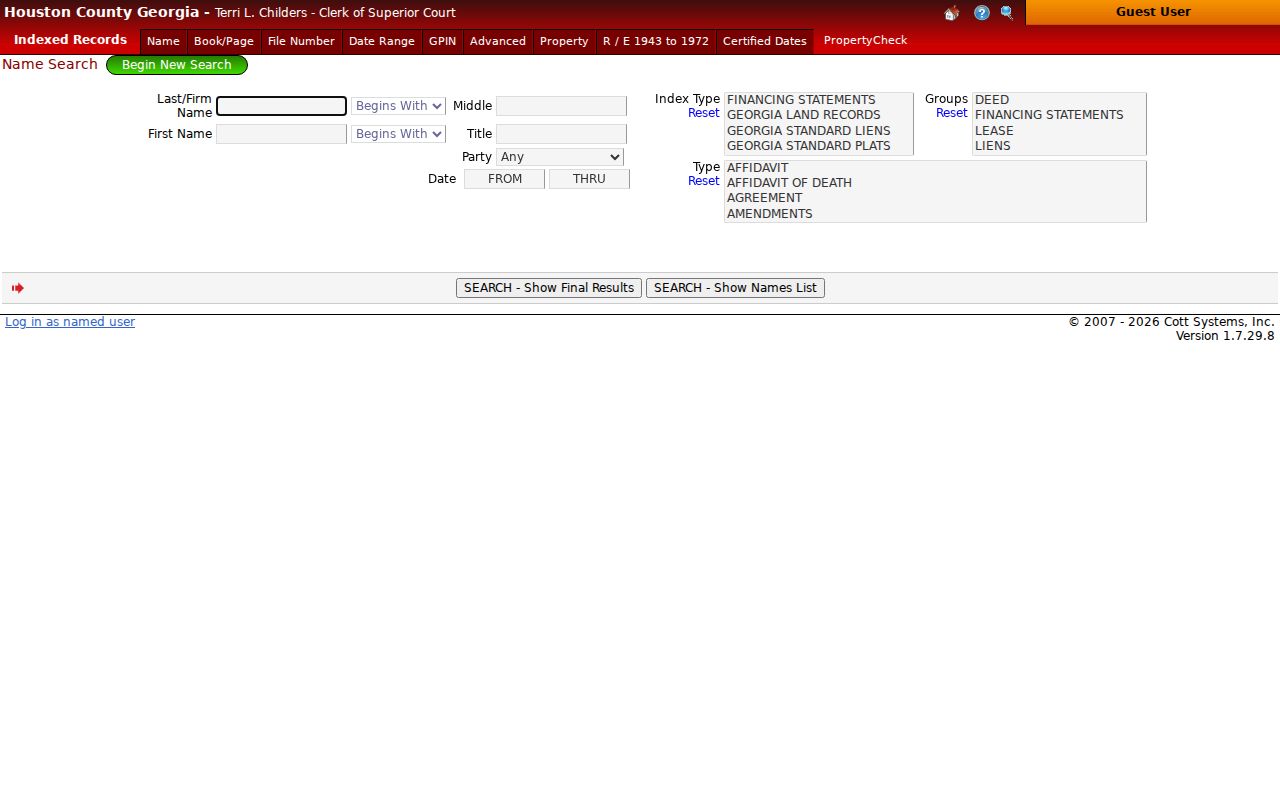
The image shows the official search page itself. It does not prove that every image is free, that older deeds are online, or that a result matches the right tract.
Reconstruct Houston Owners Backward
Treat the current parcel as an entry point only. The chain comes from recorded instruments. At each step, match acreage, lot and block, landlot and district, subdivision, plat book and page, and the deed's legal description. A familiar street address helps locate the parcel, but old deeds may not use one.
- Search qPublic by the known address. Save the complete Parcel Number, legal-description summary, sales lead, and newest book/page shown.
- Find the newest conveyance in Cott. Record its grantee, grantor, instrument type, execution and recording dates, consideration if indexed, and tract description.
- Search that grantor in the grantee role. Open the deed by which that former owner acquired the same tract, then repeat the process.
- Follow prior-deed and plat references. Stop at a changed tract, missing image, uncertain name, or pre-index date, and label the gap.
- Grantor
- The party conveying an interest.
- Grantee
- The party receiving the interest.
- Chain of title
- The ordered run of instruments affecting one tract.
- Reverse index
- An index organized from the receiving-party side of a transfer.
- Warranty and quitclaim deeds
- Different conveyance forms; neither label alone resolves every title issue.
Match Houston Land Descriptions
Names alone cannot bind former owners to one tract. Houston qPublic sample cards list the legal description, acreage, zoning, tax district, and landlot and district. The recorded deed and plat control the conveyance terms. The parcel card is just a compact tax summary. Compare both every time the chain steps back.
Descriptions shift. A deed may cover more land than the present parcel. A later plat can split the tract into lots. Correction and re-recorded deeds fix a name or description, and easements or rights-of-way can affect land without transferring full ownership. When the description changes, state what changed and hold off on calling the chain unbroken until the linked plat or deed resolves it.
Houston Chain Breaks Need Labels
Estate, trust, survivorship, executor, administrator, merger, and entity transfers can all interrupt a sale-to-sale sequence. Search both party roles. Keep the exact indexed instrument type beside every entry. If a deed party is a company, the Georgia corporations search can resolve name variants or an agent. A business filing, though, does not convey the parcel.
Label your doubts plainly. Phrases like “index entry found, image not reviewed,” “description changed,” or “possible entity transition” keep the work honest. Never insert a presumed heir. When a needed image sits behind a gate, save the book and page or instrument number and request the record from the Clerk. Treat the gap as a gap, not a transfer.
Houston Plats Split at 2017
Houston County has taken plats electronically since January 1, 2017, and paper filings are no longer accepted. The cutoff splits a subdivision's history. A new phase lands in the electronic workflow. Its parent plat may still point to an older map book page. That split does not mean the older plats vanished. Many simply sit offline in bound volumes at the courthouse rather than in any index you can open from home.
Save the plat book and page that qPublic or a deed shows. Then try the Clerk or GSCCCA. Either route can produce the image or the citation. Perry planning files cite Clairview Park at Map Book 9 page 53 from 1964, Map Book 30 page 92 from 1986, and Deed Book 218 page 99 from 1964. A modern planning file can reach back decades.
Before Houston's Online Baseline
The GSCCCA service description sets a statewide deed-index baseline of at least January 1, 1999, with historical data added over time. That floor is not Houston County's earliest online year. It is a statewide promise, and a modest one. Not every deed image falls inside it, so complete online coverage is never guaranteed.
For owners who predate that baseline, the Georgia Archives research guidance points to FamilySearch and county microfilm for many pre-1900 land records. Treat the county microfilm-card collection as a catalog. It lists what exists. Digitized deed images do not always follow. Later books generally remain with the local court in Houston County, which dates to 1821. No official statement identifies a first surviving deed book or any span of record loss.
Online cutoff. Treat 1999 as the statewide index baseline, not Houston's first deed year; search older books through the Clerk, Archives cards, and FamilySearch.
Reach Houston's Older Owners
Online access is one channel among several. The Houston County Clerk of Superior Court Real Estate Division keeps deeds, plats, and liens at 201 N. Perry Parkway in Perry. Its Real Estate phone line is (478) 218-4720. Copies run $1 for a standard page. A certified copy costs $2.50 for the first page plus $0.50 for each added page. GSCCCA image access may require an account or subscription.
When a book, image, or index export is not online, request that existing record from the Clerk by parcel, party, date range, and book and page. The Georgia Open Records Act generally requires an answer within three business days. An agency can instead explain availability, estimated time and cost, and any exemption. It need not build a new owner-history report. Library local-history collections at Perry/Nola Brantley and Centerville add context. The Clerk's recorded instrument remains the transfer source.
Know Houston Ownership Limits
A Houston County chain runs only as far as its records reach. No published year marks the earliest local deed book. No record-loss span is documented either. Archives catalog notes and old newspapers can point toward forgotten parcels, estates, and subdivisions, though neither one replaces a recorded conveyance. Tax digests filed with the state from 1872 add year-by-year clues. They prove nothing about title.
A casual owner list is not a title opinion. A deed can be recorded and still leave questions. Competing interests, defects, and instruments outside the list can all survive. Keep every source date, citation, gap, and description change visible, and use the dedicated Houston deed records page for obtaining a single deed copy while this workflow stays on time depth.
Lawful use. Research former owners for house history, estate work, or property diligence. Never use public records to stalk, harass, threaten, or approach a living person.