
Identify a Houston County Owner
A parcel number beats a name every time. The strongest route runs from address to parcel, then from the assessor owner to the latest recorded deed. Carry each identifier forward as the search moves. A common name alone is weak, but a parcel number plus legal description makes a solid match in Houston County property records.
- Search the address in Houston County qPublic. Confirm the location, parcel number, and legal description before noting the Owner field.
- Open the Clerk's Cott index. Search the parcel, book and page, or owner name for the newest deed affecting the same tract.
- Compare the grantee, recording date, prior reference, and legal description. Check for a later correction, estate paper, or conveyance.
- If an entity owns the parcel, use the Georgia corporations search to resolve its registered name or agent, not to prove title.
Precise labels beat loose claims. Call a finding an assessor digest owner, a newest recorded grantee, or a possible gap in the deed image. That honesty beats declaring legal ownership from one screen.
Houston County qPublic Owner Field
The county-linked qPublic search labels the assessment name as Owner. Keep the fields apart. A separate mailing address follows it, while the physical address pins down the parcel. An owner may get tax mail elsewhere. The parcel itself may sit vacant or hold someone other than the owner of record. Sample reports also show the parcel number, legal description, class, zoning, tax district, land lot and district, acres, sales, deed book and page, improvements, permits, and map context. The Owner field is a strong lead. It is still not a deed.
Note: Search a new purchase by address if the buyer's name has not yet reached the assessment roll.
January 1 Owner Timing
Houston County's assessment FAQ says notices go to the owner of record as of January 1. A later sale can create a short-term mismatch between the roll and deed index. No official fixed qPublic refresh interval was located, so a precise lag should never be promised.
The portal may say current values are under construction. That warning is also a cue to record the search date. When timing is close, the newest deed found through the Clerk carries more weight for the identity question.
Houston County Ownership Sources
Houston County property records draw on three official sources. Each contributes different evidence, and their fields should agree on the parcel even though no two share a legal purpose or an update schedule.
| Source | Owner Info It Gives | Access |
|---|---|---|
| qPublic assessment roll | Owner, mailing address, situs, parcel and sale references | County-linked portal |
| Cott deed index | Newest grantee, grantor, date and deed reference | Property and name routes |
| Georgia SOS | Entity name, control number, agent or officer options | State corporations search |
| County GIS | Tax-map context tied to parcel identity | Viewer reports an outage or upgrade |
The Cott property route confirms ownership. A deed's grantee is the recipient of that transfer. The deed must still describe the same land, and a newer instrument can change the answer in the deed records.
See Houston County Parcel Evidence
The official qPublic landing page is the county's assessment entry point.
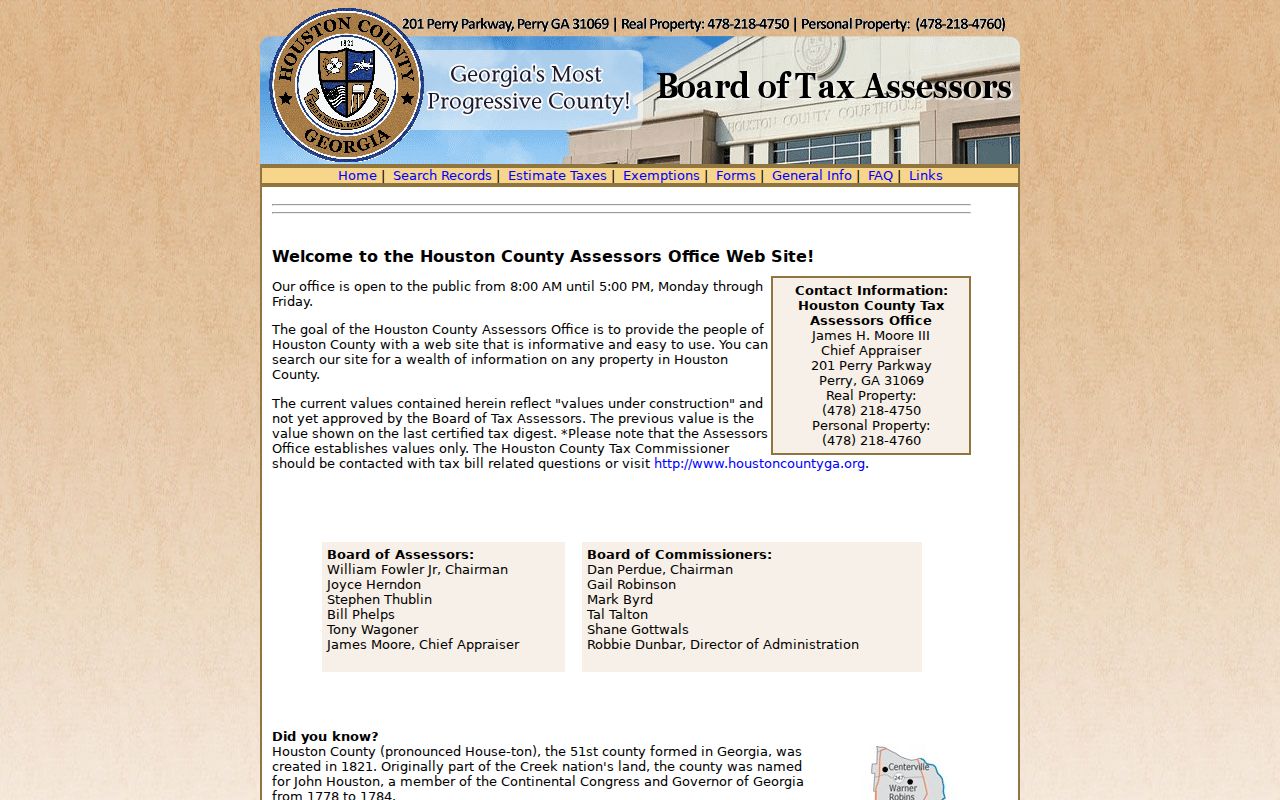
The official parcel view shows the source to check before a deed search. Save it with the parcel number and access date.
- Owner of record
- The party named in the public roll or deed for the parcel.
- Grantee
- The person or entity receiving a recorded interest.
- Situs address
- The parcel location, distinct from its mailing address.
- Title
- Legal rights in land, which a quick lookup does not fully establish.
Entity Owners in Houston County
An LLC name on qPublic deserves a second stop. Search it in the Georgia corporations database, which offers exact, contains, starts-with, control number, registered agent, and officer options. That search can resolve punctuation and suffix puzzles. A corporate filing is still not a conveyance. Only the latest deed links an entity to the land. Trust and estate names may need both grantor and grantee searches plus checks for corrections, executor papers, or survivorship language.
City Clues for Houston County Owners
Warner Robins, Perry, and Centerville addresses all sit inside the Houston County property system. A postal city or ZIP orients the search. It proves nothing about a municipal boundary. Compare tax district, parcel map, zoning, and deed description. Warner Robins property records add city planning context, while ownership still points back to county deeds and assessments.
Limits of a Houston County Owner Search
A search result has limits. It can identify the assessed owner and the newest recorded grantee without proving the full state of title. It does not show who lives there. It may omit a protected address, show a stale roll name, or leave an index image behind an account requirement. Record the gap and ask the custodian. Georgia law also shields certain personal fields; Houston County offers a tax-assessor non-disclosure form for qualified protected officials, and Georgia VoteSafe can guard a qualified voter's residence address. Those safeguards are not meant to be bypassed.
Lawful use. Use Houston County owner records for property research and due diligence, never to stalk, harass, threaten, trespass, or expose a protected person.
Save Houston County Owner Proof
Keep a paper trail. For every step, save the query, access date, parcel number, situs, legal description, assessor Owner field, mailing field, and newest deed citation. If an image is gated, save the index result. Request the copy from the Clerk. Houston County lists standard and certified-copy charges, though online image access may carry account limits.
The deed index opens through both property and name routes. Try initials, spelling variants, and suffix forms. Search grantor and grantee roles too. The parcel description is the control that tells apart two people or entities with similar names.
A confident answer names its source and its limit. Say "assessor digest owner" for qPublic, "newest recorded grantee" for a confirmed deed, and "possible gap" when the newest image or matching description could not be checked.
Ask Houston County for a Copy
The Real Estate Division of the Houston County Clerk of Superior Court keeps the county's deeds, plats, and liens. Find it at 201 N. Perry Parkway in Perry. The Real Estate line is (478) 218-4720. A standard copy costs $1. Certified copies run $2.50 for the first page plus $0.50 for each additional page. When you request a copy, give the book and page, instrument details, parcel number, and party names. It proves exactly what the office recorded. A certified copy is still not a title opinion, though, and for a careful present-owner check the Houston County current owner record follows roll timing and the newest deed.
Resolve Houston County Search Conflicts
Suppose qPublic and the newest deed name different owners. Start with dates. The January 1 assessment rule can leave an old name on the roll after a later closing. Then compare the parcel number, acreage, legal description, plat, and the prior deed reference. A correction deed or a partial transfer often explains why two results seem to describe one address.
Search name variants only after the land itself matches. Try the surname alone, a first initial, the full name, and any company name with or without its suffix. Run both grantor and grantee roles. GSCCCA standards warn that spelling and indexing forms vary. One empty query is not a reliable end point.
If an image is unavailable, ask the Clerk for the recorded instrument instead. Do not lean on the assessor sale history. That history may list the date, book and page, price, reason, grantor, and grantee, but only the deed carries the conveyance language and the legal description.
Houston County Owner Contact Boundaries
A public mailing address can reasonably support a short letter about a purchase inquiry, boundary question, or easement. It is not an invitation to visit. The occupant of the situs may not own it. An LLC agent may be the proper business contact. Use only the fields your property task needs. Avoid republishing private identifiers, and honor any redaction the record carries. A public parcel record opens a record; it does not grant permission to pressure anyone.
Note: A Houston County owner result is strongest when the qPublic parcel, the newest deed, and the legal description all point to the same tract. Check that alignment before you rely on the result.
Certified copies come from the Clerk alone. qPublic handles the assessment data. Keep those two roles straight whenever ownership affects a purchase, estate, or boundary decision. Name the unresolved point, then ask the Houston County office that holds that exact record.