
Compare Houston Property Values
A single Houston County parcel can carry numbers that answer very different questions. The Tax Assessor estimates fair market value to drive the assessment process. Georgia's general 40 percent level then converts that estimate into assessed value. A sales row or recorded deed can show consideration from a past transfer. Land, improvements, and accessories may also appear as separate parts of the assessor's total.
Never substitute one figure for another. Each value needs its year, its source, and its status. The qPublic notice can mark current values as under construction, while an older figure may simply be the last certified digest value.
| Value Type | Meaning | Record Source |
|---|---|---|
| Assessor fair market value | County estimate as of the valuation date | Houston qPublic assessment card |
| Assessed value | Generally 40% of fair market value before exemptions | Assessor value fields and notice |
| Last sale price | Indexed consideration from a prior transfer, when shown | qPublic sales row and recorded deed |
| Land, improvement, accessory | Components used in the parcel's value history | qPublic value-history module |
A sale price reflects one transaction. It happened once, on one date, between two parties. The assessor value comes from the public tax process, and the assessed value is its statutory percentage. Neither number promises what another buyer would pay today.
Houston's 40 Percent Formula
Houston County's 2025 assessment document states the relationship plainly. Fair market value multiplied by 40 percent equals the assessed figure. Tax estimates then subtract exemptions from that amount and apply millage. One mill means one dollar per $1,000 of assessed value. The bill, the exemptions, and the appeal route belong to Houston property tax records.
Here is a quick illustration. The assessed field should equal 40 percent of the assessor's fair market figure before exemptions. That check can catch a transcription error, though it is not an independent valuation. Homestead and other programs can change the taxable base. They can do so without moving the assessor's full fair market estimate at all.
Date Every Houston Value
The Houston qPublic home posts an important status warning. Current values may be under construction and not yet approved. The previous value is the last certified digest figure. The official portal page displays that notice itself, so a visitor sees the status of any Houston County value before relying on it.
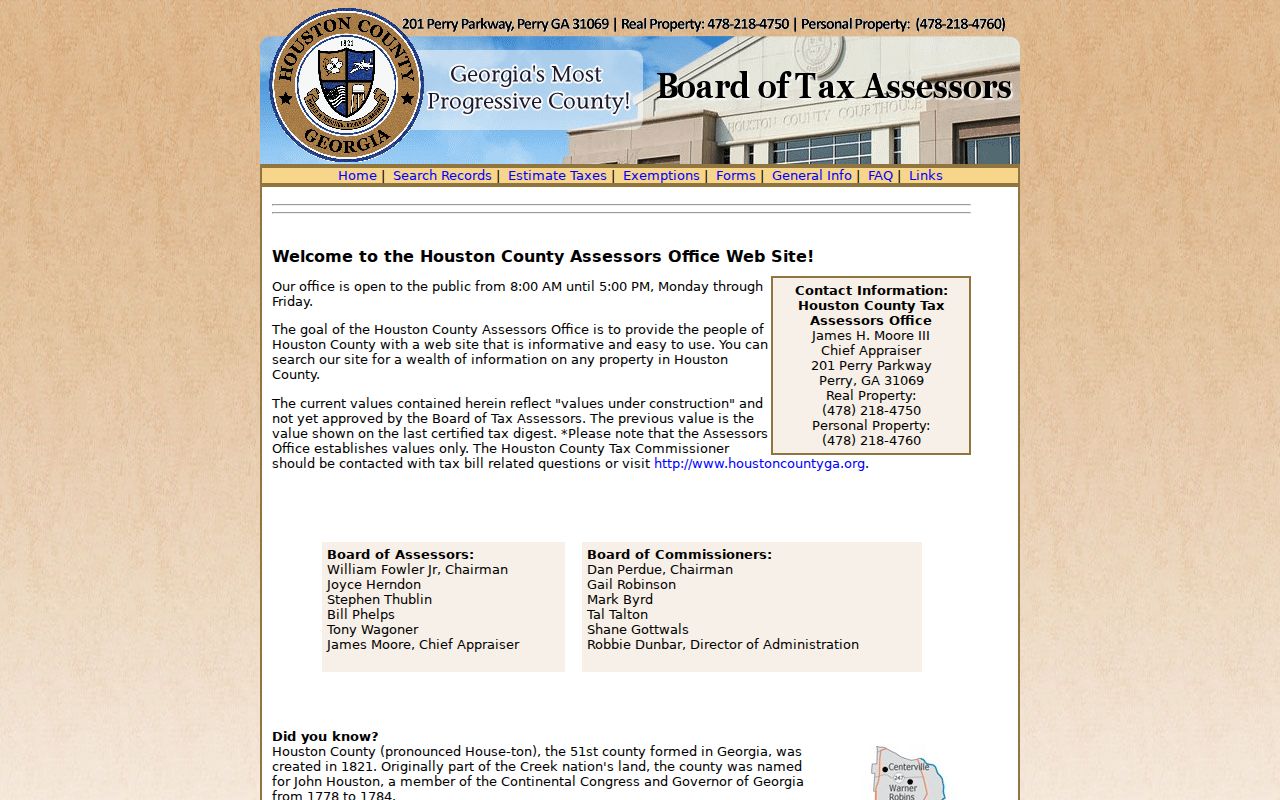
Note what you record for every value: the date viewed, the tax year shown, whether the figure is under construction, and which amount is certified. The county publishes no fixed refresh schedule or standard lag interval for these updates.
Note: A portal label such as “current” still needs its tax year and construction or certification status.
Estimate Houston Value From Records
The county-linked qPublic route ties each value to a Parcel Number and location address. Preserve the full identifier, zeroes and letter prefixes included. Then read the value history separately from the sales history. A deed check can confirm that a sales row matches a recorded transfer, but the transaction amount still is not a current appraisal.
- Search the address or complete Parcel Number in the Houston County qPublic portal. Confirm the location address and legal-description summary.
- Write down the tax year, fair market figure, assessed value, and land, improvement, and accessory components shown.
- Note any under-construction warning and compare the prior certified digest value in the history module.
- Read the sale date, price, reason, grantor, grantee, and book/page, then verify the cited transfer in the Clerk index when needed.
- Assessed value
- The statutory percentage of fair market value used in the tax process.
- Fair market value
- The assessor's estimate of full value as of the valuation date.
- Assessment ratio
- The relationship between assessed and fair market value, generally 40 percent in Georgia.
- Sale or consideration price
- The amount tied to a transfer when the index or instrument reports it.
- Reassessment
- A new review or change to the value placed on the parcel.
Read Houston Value History
An official county agenda sample from June 2021 includes qPublic value-history rows with year, previous value, land value, improvement value, accessory value, and current value. The same report carries a separate sales table and a last-data-update area. That separation is useful. It stops a reader from treating an assessor's change as a sale. It also stops the reverse mistake, reading a sale as the assessor's current estimate.
Track why the components changed when the record supplies a reason. New construction matters. So can removed improvements, a parcel split, a changed classification, or a broad valuation update. Each of those affects the total differently. County guidance states a January 1 valuation date but no countywide reassessment interval. So do not promise an annual reappraisal schedule.
Separate Houston Sale Price
qPublic sample sales rows can show sale date, deed book and page, and plat book and page. The rows also list sale price and reason. Grantor and grantee appear too. Use those fields as a bridge to the recorded deed. The Clerk's Cott property and name searches can confirm the instrument. GSCCCA, where available, can confirm the legal description.
A recorded price needs context, though. It may involve a multi-parcel transfer, an entity change, or an estate matter. It could also be another deed type. Another deed type may not be a simple open-market sale. Check the reason and instrument before using it as a comparison. Even a clean arm's-length sale captures a past date, a parcel condition, and a bargain. That is not today's Houston property value.
Houston Ratios Tell a County Story
The county's appraisal guide reports historical sales-ratio figures of 38.02 percent in 2018, 37.02 percent in 2019, 36.26 percent in 2020, 36.88 percent in 2021, and 34.73 percent in 2022. The guide calls 40 percent the ideal assessment ratio. It also discusses concern and penalties when county ratios fall lower. These are dated countywide measures, not the assessment percentage on one parcel.
That history explains the countywide story. Assessment work may adjust many parcels even when a particular home never sold. It does not license multiplying one old sale by a countywide ratio to declare a current value. Use the live parcel card. Use its year. Use its status.
| Year | Historical County Ratio | Proper Use |
|---|---|---|
| 2018 | 38.02% | Countywide historical context |
| 2019 | 37.02% | Countywide historical context |
| 2020 | 36.26% | Countywide historical context |
| 2021 | 36.88% | Countywide historical context |
| 2022 | 34.73% | Countywide historical context |
Choose Sound Houston Comparisons
A good comparable starts with the right basics. Property class, acreage, zoning notation, improvements, conservation-use status, tax district, and setting all matter. Any one of them can make two sales a poor match. One official sample parcel, 116 Hay Road, illustrates the problem. It carries a conservation-use class, RAG zoning, 153.63 acres, and detailed improvement fields. Treat that rural parcel as a warning. Do not use it as a comparable for an urban Warner Robins or Perry sale.
City growth records add context rather than appraisal proof. DCA material reports Warner Robins adding 586 acres. It also reports Perry adding 570 acres since the prior plan cycle. Annexation, new plats, and zoning cases can shape future use. They still set no assessed value and prove no sale price. Verify the parcel's own county record before relying on any comparison.
Find Houston Value Sources
The direct qPublic parcel search is the main online route into Houston County property records. The Tax Assessor establishes and appraises value. The Tax Commissioner handles bills, balances, and payments. Do not confuse those billing fields with the assessment fields themselves. A portal can fail. An older digest may be needed. In that case, ask the Assessor for an existing parcel card, digest entry, or value-history record.
A focused Georgia Open Records Act request can work too. Include the parcel number, tax year, date range, desired format, and a fee ceiling. State guidance says an agency generally responds within three business days. Otherwise it explains availability, estimated time, cost, and any exemption. The office need not create a new appraisal or a custom comparison report.
Limit a Houston Value Claim
An assessor value serves the public assessment process and nothing more. It does not promise a future contract price. It cannot reflect every repair or defect. And it never replaces a property-specific appraisal. A qPublic figure may still be under construction. The last sale on record can be old. Or it can be shaped by terms that would not fit a new transaction.
Whenever citing a Houston property value, state the source, year, status, and value type. For a purchase or sale decision, lean on current market evidence. Also lean on professional advice suited to the purpose. For an exact tax amount, exemptions, or an appeal, use the Tax Commissioner or Tax Assessor process. Do not stretch the value card beyond its role.
Value is not price. Houston assessed value supports taxation. It is not a promise of sale price and is not a licensed appraisal.