
Houston County Owner Record Card
On the Houston County qPublic parcel card, the assessment name carries the Owner label. Mailing address and physical location address sit in separate fields. One card can hold the parcel number, legal description, class, zoning, tax district, acreage, land lot and district, sales, value history, improvements, permits, and map context.
| Owner | The name carried on the assessment roll |
|---|---|
| Mailing address | Where assessment or tax mail is directed |
| Location address | The situs, or physical parcel address |
| Parcel and description | Keys used to match the same tract across records |
| Sale reference | Date, deed book and page, grantor, or grantee when listed |
Owner of record and occupant are different things. A company may own a leased building. A trustee may hold title. Tax mail may go somewhere else entirely. Treat the mailing field as a lawful contact clue for a property matter, never as proof of where the owner lives.
Check the Houston County Owner Field
Open the Houston County qPublic parcel search and search by street address. Keep any leading zeroes or letter prefixes in the parcel number. Confirm the location first. Then confirm the legal description. Check this especially where streets share a name before reading the Owner field. Houston County publishes sample parcel reports with LLC owners. Those dated examples show how an entity name and mailing address can appear together. They also show parcel facts, zoning, and improvement modules in one place. They are not current ownership claims.
How Current Is Houston County Data
Assessment notices are sent to the owner of record as of January 1. Houston County's 2025 FAQ tells a newer buyer to search by address when a name search does not show the buyer. That is direct evidence of a timing gap, though no official fixed owner-field refresh interval was located.
qPublic can also display a current-values-under-construction notice. That notice says the previous value is the last certified digest value. It does not establish the deed status, so treat the current owner question and the current value question as separate checks.
Recent sale. The roll may still name the January 1 owner; use the newest recorded deed to check a later transfer.
View Houston County qPublic
The official qPublic home is the county-linked source for parcel assessment records.
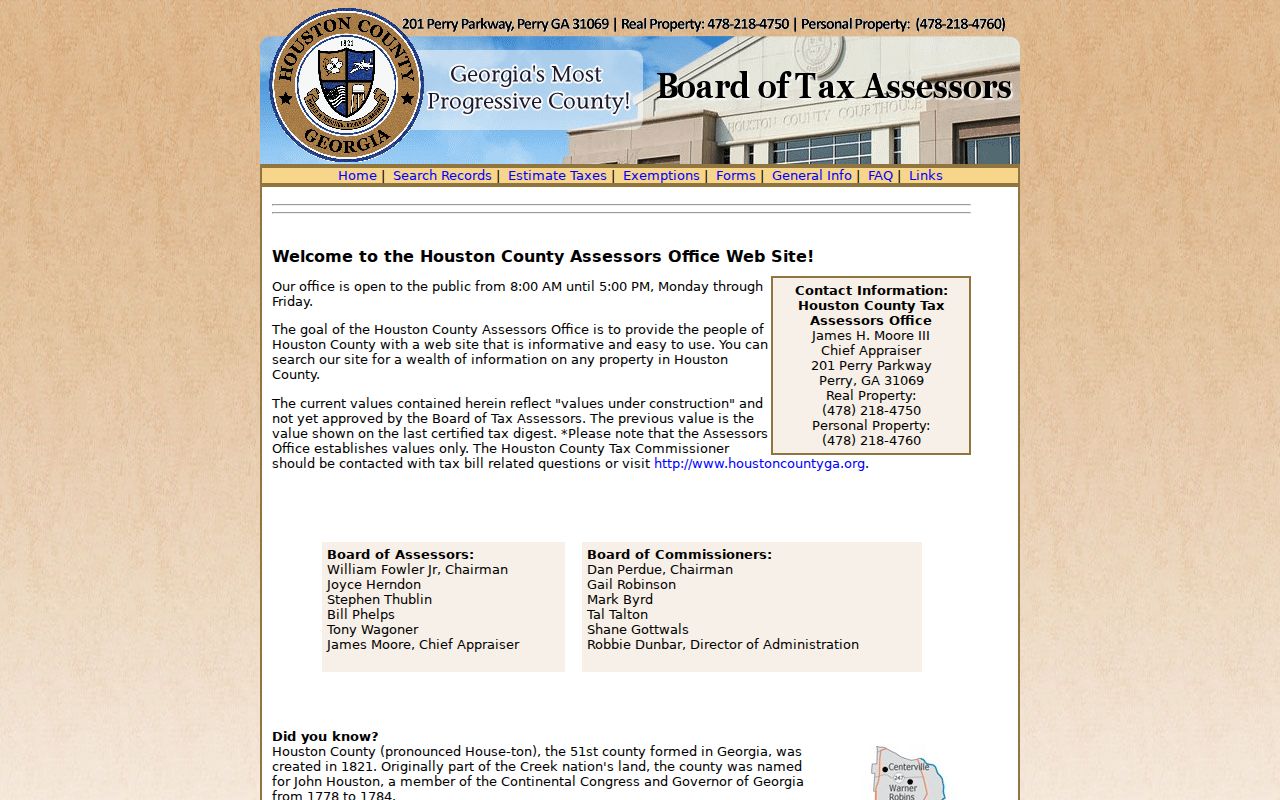
The qPublic entry page links to the official parcel search. Save the source date and exact parcel number alongside any current-owner result.
Confirm Houston County Current Ownership
A present owner check ends with the newest deed, not a backward title chain. Match one assessor parcel to the most recent recorded conveyance describing the same tract.
- Read the qPublic Owner field and save the parcel, situs, mailing address, legal description, and newest sale reference.
- Search the Houston County Cott index by property, book and page, or party name.
- Compare the newest grantee, recording date, consideration where shown, and legal description. Check for a later deed or correction.
- Label any missing image or changed description as a gap. Contact the Real Estate Division rather than filling the gap by inference.
- Owner of record
- The party named on the assessment roll or recorded deed.
- Assessment roll
- The county digest used to appraise and assess parcels.
- Vesting
- The wording that states how a grantee receives an interest.
- Recording lag
- The time between a sale and its appearance in another public system.
Houston County Entity Owners
An LLC in the Owner field calls for the Georgia corporations search. Use it to resolve the exact name, control number, registered agent, or officer. Search modes cover exact, contains, and starts-with, which helps separate similar company names. The Secretary of State filing proves nothing about title. Only a recorded conveyance ties the entity to this parcel. For a trust or estate, the deed index helps. Try trustee, executor, administrator, survivorship, or correction terms. Note: Keep the entity lookup and the parcel deed together. Either record alone answers only part of the identity question.
When a Deed Image Is Missing
Seeing an instrument in the index does not mean its image is open online. Record the instrument type and recording date. Note the grantor and grantee too. Add the book and page or instrument number, and any image-access note. The Houston County Clerk's Real Estate Division can supply a local copy. A standard copy runs $1. A certified copy is $2.50 for the first page plus $0.50 per added page. Call the Real Estate Division at (478) 218-4720 to confirm the record and current process. An open-records request can also seek a specific existing record. The direct custodian route is often clearer, though.
Protected Houston County Addresses
Houston County offers a tax-assessor non-disclosure request for qualified protected officials. The form asks for role and agency details and needs office approval. It is not a general privacy option. Separately, Georgia VoteSafe protects residence data for qualified voters who meet its criteria. A missing address should stay missing. Do not rebuild it from unrelated records. Public access to parcel and deed fields never permits exposing a protected person.
Contact a Houston County Owner
The tax roll's mailing address is the most direct public route. It reaches a Houston County owner of record. State the parcel and purpose in a brief letter. Do not assume the mailing place is the owner's home. Never approach an occupant based only on an ownership result. For the broader address-to-owner method, see the Houston County owner lookup. Keep the present record separate from former owners and the older deed chain.
Lawful use. Contact a Houston County owner only for a lawful property matter; never stalk, harass, threaten, trespass, or expose a protected person.
Document Houston County Currentness
Every finding about a Houston County parcel deserves a date and a confidence note. Record the qPublic access date alongside the current-values notice. Save the parcel number and the Owner field first. Then add both mailing and situs addresses, the sale reference, and the newest Cott index result as part of your Houston County property records file. Should the legal description shift, or the image stay unchecked, name that gap precisely. Precision here beats speed.
A qPublic sale table is a lead, never proof. Its date, book, and page can point you toward a deed. So can its price, grantor, and grantee fields. The Clerk's recorded instrument remains the confirming source for any Houston County property search. Liens, tax bills, and company registrations add texture the same way. None of them alone establishes who holds the parcel.
Keep the sharpest distinction in view. An assessor digest owner and a newest recorded grantee are different answers. The January 1 notice rule governs the digest. Right after a transfer, claiming one as the other is easy to do. It produces a false statement about the owner of record.
Houston County Owner Source Notes
The statewide GSCCCA deed index has an all-county baseline since at least January 1, 1999. Older data was added over time. That does not promise that every Houston image is online. It also does not promise that the county's oldest indexed deed begins in 1999. For current-owner work, only the newest matching conveyance matters.
If no result appears, try the property route. You can also try the name route, initials, surname variants, or entity suffixes. Compare the legal description each time. A failed name query does not prove that no owner record exists, especially after a recent sale.
Current Houston County Record Checklist
A solid current-owner note names the parcel, situs, assessor Owner field, roll date context, newest deed grantee, and recording date. Add the deed reference too. Say plainly whether the mailing address differs from the parcel location. When an entity appears in the Houston County property records, include just the official corporation result. That distinguishes it from similarly named ones. Anything more invites confusion.
If the newest index image goes unconfirmed, say exactly that. A clear gap beats a guess every time. The Real Estate Division can verify the cited instrument. The Tax Assessor can explain the current digest owner. Those two contacts keep deed status and assessment status cleanly separate.
Handle privacy with equal discipline. A protected or redacted residence address must never be reconstructed. Ownership data supports lawful Houston County deed records research, not unwanted contact with an occupant.
Note: Recheck the newest Houston County deed whenever the parcel has sold since the January 1 assessment date.