
Houston County Tax Record Fields
Two offices split the work. The Tax Assessor appraises real property and keeps the assessment roll. The Tax Commissioner bills and collects. On a qPublic parcel card you can find value, classification, exemptions, and the owner used for assessment. The Commissioner's system, in turn, verifies the bill and payment status. Houston County sends each question to a specific desk. Mixing the two duties can delay an answer about your parcel.
| Field | What It Shows | Where |
|---|---|---|
| Fair market value | County estimate of full value as of January 1 | qPublic parcel card |
| Assessed value | Forty percent of fair market value before exemptions | Tax Assessor |
| Exemptions | Homestead status and deductions that may apply | Tax Assessor |
| Tax district and millage | Jurisdiction fields used in the tax calculation | qPublic and bill |
| Bill and balance | Amount billed and current payment information | Tax Commissioner |
An assessment is not a bill. Houston County starts with fair market value, multiplies by 40 percent for assessed value, then subtracts exemptions. After that, the county applies millage. One mill equals one dollar per $1,000 of assessed value. Check current millage on the current bill, because older county examples are not today's rates.
Houston County Tax Offices
The Houston County Tax Assessor covers appraisal, the digest, exemption applications, and assessment questions. The Houston County Tax Commissioner covers billing, collection, and payment. Both offices share parcel identifiers, yet each keeps its own record.
Tax Assessor
Use qPublic for parcel facts, value history, land and improvement values, acreage, zoning, tax district, owner fields, and homestead display.
Tax Commissioner
Use the tax route for the current bill, balance, and payment. A convenience fee may apply to online payment.
The county publishes no current delinquent-tax or tax-sale calendar. Confirm any tax-sale or delinquency question with the Tax Commissioner rather than trusting an old notice.
Read Houston County qPublic Values
The county-linked qPublic parcel search connects a parcel number to location, legal description, class, zoning, tax district, millage, acreage, homestead status, and land lot and district. Owner and mailing address may appear too. Sales, value history, improvements, permits, a map, and a photo round out the parcel record.
| Field | How to read it |
|---|---|
| Parcel number | The county identifier used across value and map records |
| Previous value | The prior value shown in the history table |
| Land, improvement, accessory | Parts that combine into the parcel's current value |
| Sale table | Dates, deed references, price, reason, grantor and grantee when listed |
| Homestead | The exemption display, which should be checked against the current filing |
The portal warns that current values may be under construction. When that notice is up, the previous value stands as the last certified digest value. Read it before comparing Houston County property tax records across years.
Houston County Value History
An official county agenda included a qPublic report listing year, previous value, land value, improvement value, accessory value, and current value, plus a sales table and a last-data-update area. Those columns let an owner separate rising land from rising buildings. The total stops being one unexplained number.
The Houston County qPublic home carries the live parcel record. Read its current-values notice before quoting any value.
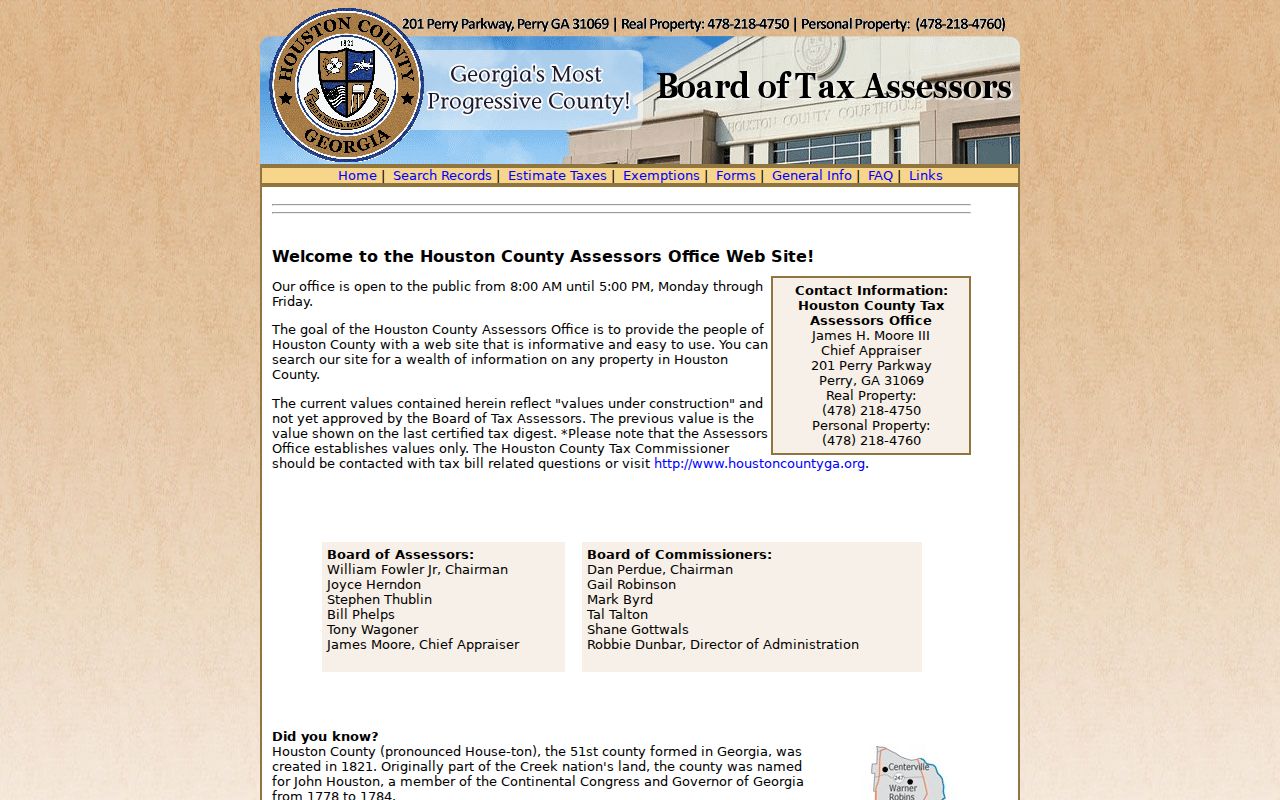
The county's official qPublic route is the page to bookmark; save the parcel result and notice with the date of the search.
Countywide sales ratios ran 38.02 percent in 2018, 37.02 percent in 2019, 36.26 percent in 2020, 36.88 percent in 2021, and 34.73 percent in 2022. They describe appraisal conditions across the county, never the ratio for a single parcel.
Look Up a Houston County Bill
Begin with the parcel, not the name. That habit keeps similar street names and recent owner-name changes from creating a false match. It also sets the qPublic assessment beside the Tax Commissioner's record for an easy comparison.
- Search qPublic by address. Save the complete parcel number and verify the location and legal description.
- Read the market, assessed, land, improvement, exemption, district, and millage fields. Note any under-construction warning.
- Open the Houston County tax site and use the matching parcel to review the bill and payment status.
- Ask the Assessor about value and the Commissioner about collection if the records do not align.
- Assessed value
- Forty percent of fair market value before exemptions.
- Millage
- The rate applied after assessment and exemption steps.
- Homestead exemption
- A deduction for a qualifying owned and occupied legal residence.
- Tax lien
- A claim connected to unpaid tax; it is not ownership proof.
Houston County Homestead Filing
County guidance sets April 1 as the homestead filing deadline. Standard and senior amounts in a separate county guide are historical reference figures. So confirm current eligibility and benefit with the Assessor. The 2025 assessment FAQ also described an HB 92 second filing chance during the appeal period. That chance was for a qualified January 1 owner. The procedure belonged to 2025 alone, not a standing promise for later years.
Note: The qPublic homestead display is helpful, but the Assessor decides current eligibility and applications.
January 1 Sets Houston County Value
Georgia and Houston County set fair market value on January 1. The owner of record on that date receives the assessment notice. A buyer who closed afterward may not show up in an owner-name search. The county FAQ advises a new owner to search by address instead.
The timing quirk matters. A Houston County property tax search can be accurate for the digest. It may still list the prior January 1 owner. For a recent ownership change, the newest recorded deed is the better source.
Appeal a Houston County Assessment
File an appeal within 45 days of the assessment notice. Include owner and contact information, the property address or parcel number, the appeal ground, and supporting documents. Grounds cover value, taxability, and uniformity. Millage and levy amounts are not appeal grounds.
Appeal window. File with the Houston County Tax Assessor within 45 days of the notice and keep proof of timely delivery.
Good support includes sale papers, an appraisal, repair estimates, dated condition photos, comparable sales, or classification records. An appraiser may inspect the parcel. The Board of Tax Assessors reviews the appeal first, then a Board of Equalization hearing or arbitration follows, with Superior Court available where applicable.
Request Houston County Tax Records
Ask the office that keeps a record. Do this when the portal will not load. It also applies when the entry you need is missing. Name the parcel. Give the date range and the specific record itself. Under the Georgia Open Records Act, an agency generally responds within three business days. Otherwise it explains the expected time, cost, and any exemption.
The office does not have to build a report that does not exist. Search and retrieval are generally free for the first 15 minutes. After that, the lowest-paid qualified employee's hourly rate may apply. Copies often run ten cents per page under state guidance. Office charges still govern.
Compare Houston County Tax Years
Compare the same parcel at the same value stage. Pull the land, improvement, accessory, current, and prior figures from qPublic. Note whether each number is under construction or certified. Then check exemption status and tax district. A bill can change for reasons beyond a shifted market estimate, so the assessment and collection records deserve separate lines rather than one collapsed number.
Sale history helps, but it is not a present appraisal. A sale row may list date, deed book and page, plat book and page, price, reason, grantor, and grantee. Confirm that row in the Clerk's index first. A family transfer or partial tract can make a poor value comparison. Treat other non-market transactions the same way.
Houston County's historical sales-ratio series is broad evidence about the county digest as a whole. It cannot price one home. It should not be applied as a private parcel formula.
Prepare a Houston County Tax File
Build the file around the assessment notice, qPublic parcel card, current bill, exemption proof, and any supporting value evidence. Mark each item with its source and access date. If an appeal is filed, keep the submission, delivery proof, office response, inspection notes, and hearing papers.
Save the newest deed reference too. For a purchase or sale, add the legal description. That does not turn a tax review into a title search. It keeps value evidence tied to one parcel. When the question is what a number means rather than the bill itself, the Houston County property value page separates assessed, market, and sale figures.
Houston County Tax Search Checks
Check the basics first. Confirm the parcel number, legal description, tax district, value year, and value status before relying on Houston County property tax records. Then verify the bill. The Tax Commissioner holds the current figure, and a portal result without its year or construction notice is easy to misread. Keep current official pages in the file. Rates, forms, and notices change, so the current notice and current bill control the immediate tax question, while historical examples only help when labeled with their year.